March
22, 1973 - San Carlos, California
I
turned around in my front row seat to watch Marlene Dietrich scurrying
down the aisle past me, generating a baby blue vortex of Chanel-scented
air as she sprinted toward the unlit stage of the Circle Star Theatre.
Glancing over her shoulder to memorize her route she noticed me sitting
there alone, an audience of one in a two thousand-seat theatre, then
continued
down the aisle counting to herself with each step. Rehearsal had begun.
“Twenty-two,
twenty-thwee, twenty-four...” she muttered and then, looking straight
forward,
head tilted up, she used the golden tips of her sequined high heels to
feel out the three steps leading to the circular stage. She raised
herself
up so gracefully it was as though some invisible hand was lifting her
and
gently placing her back down. She was rehearsing her entrance down the
steeply raked aisle and feeling out the steps for that evening’s
opening.
As long as she was there, she'd sing a couple of songs.
I was
startled - though I'm easily startled - because A) I had just smoked a
joint with her stage manager in the alley next to the theatre (Yes, it
was the seventies) and B) I was assured that Dietrich never attended
orchestra
rehearsals; certainly never on her opening night; and if she did
attend,
she never, ever sang.
Dressed
in a light blue denim pantsuit with wide bell-bottoms and tightly
tailored
jacket, her outfit was topped by an enormous denim Dutch boy cap
perched
upon unkempt tangles of ash blonde hair. With pie-plate sized
sunglasses
obscuring her eyes, she was heading straight for the microphone. The
sparkling
golden shoes were anachronistic to her blue jean ensemble but the
three-inch
heels were the ones she would be wearing for the performance that
evening
and she needed to be sure of her footing. She was not happy.
Stan
Freeman, her musical director and my best friend, was conducting the
orchestra
and had just begun the introduction to “Where Have All The Flowers
Gone?”
which Dietrich sang as an anti-Viet Nam War protest. Stanley was
looking
at his music when she glided unseen onto the stage behind him and he
jumped
a foot when she started to bark out orders. A few of the musicians
tapped
their instruments as a way of acknowledging her presence but she either
didn't notice or didn't care. The music continued.
“Get
me a wamp! I need a wamp! I can't climb steps with a spotlight in my
eyes.
I WANT A WAMP!” It dawned on the stoned-out stage manager that he was
responsible
for satisfying such a request and began darting around trying to locate
a “wamp” as the work lights suddenly popped on. Although the stage
would
revolve a complete 360 degrees for her performance, it was stationary
for
now. The great Dietrich faced me as she grabbed the microphone and
caught
up to the song, joining in on “…long time passing…Where have all the
flowers
gone, long time ago?”
Without
makeup, standing under stark work lights that bleached the color from
her
hat, her clothes and the lines from her face, she was transformed into
a black and white image. I felt as though I was watching an early film
of Dietrich and not a live person. She was mesmerizing. There was
something
so compelling about her presence that you appreciated why she had
departed
the rank of movie star and had arrived at living legend.
I was
so taken by the sight of her that I almost forgot how cold it was in
the
domed cavern - what seemed a few degrees above freezing. Dietrich told
us all in the limo on the ride out that she wanted the air to be
glacial
so that the audience would remain alert. At this temperature, they
would
congeal. Standing at the mike, she was singing full out,
“Where have all the graveyards gone long time passing?"
"Where have all the graveyards gone long time ago?” in a low rumbling
monotone
that made her sound more like an ancient monk chanting than a chanteuse.
Suddenly
she stopped. “Whewe are de bullets? Wemember de bullets!” she
admonished
Stanley.
“I’ll make sure they’re louder, Marlene,” bellowed Stan as he abruptly
waved the orchestra to a stop. “At numbers 78 and 79, those violins are
fortissimo and multi-pizzicato. They should sound like gunshots.”
“And bullets!” added Dietrich.
The
orchestra began again and the violins pierced the air with their
staccato
shrapnel stings as Dietrich sang on to the end of Pete Seeger‘s
masterpiece.
She
stepped back from the mike as Stan told the orchestra that the next
song
was, unlike Dietrich’s current mood, bouncy and whimsical. It was
Charles
Marrowood‘s Australian novelty number, “Boomerang Baby.” Stan started
the
slinky vamp and Dietrich purred into the mike,
“Boom boom boom boom boom-a-wang, baby.
Fly, fly away, fly away from me, you boom-a-wang baby.”
When
she got to the spoken bridge of the song, she took off those enormous
sunglasses
and looked me right in the eye, “Hey there. Back so soon? Have a nice
twip?”
She finished the song and asked again, to no one in particular, “Whewe
is my wamp?”
The
stage manager, still too stoned to move quickly, sauntered down the
aisle
and assured Marlene that a ramp was being taken out of storage and
would
be in place within fifteen minutes.
“I will not be lied to,” she said with sharp finality.
Muttering
something to the effect of “Everybody lies to you,” the worker set off
again to look for a “wamp.” I recalled a story Stan told me about
conducting
for Dietrich during her Tokyo engagement at the Imperial Hotel when a
concertmaster's
lie very nearly led to an International incident.
The
Japanese rehearsal was to begin at one p.m. By one-thirty, only half of
the local Tokyo musicians had arrived and Dietrich asked where the
other
half were and why they were so late? It was “un-pwofessional! “
The
concertmaster, bowing excessively low, indicated to Miss Dietrich that
the string section was stuck in a massive traffic jam near the Ginza
and
would arrive at the venue shortly. Dietrich thought it a was strange
explanation
and asked a very logical question, “Do they all dwive here together in
one car?” The concertmaster responded with another plastic smile,
more excessive bow and backed away from her without further comment.
Ten
minutes more went by when Dietrich encountered the first violinist and
asked him where the other musicians were?
“They called in sick,” he told her, “and the producers were finding
substitutes.”
Another bow.
Stan
reported that Dietrich went ballistic. She drove her foot through the
floorboard
of political correctness and shattered it by saying, “Stop! I have now
been told two diffewent stowies. First, the musicians are delayed by
twaffic
and now you tell me they are all sick. This is not acceptable. You have
pwoven to me once and for all that the Japanese are sneaking, thieving,
lying little people and I have not forgotten Pearl Harbor!” Marlene was
not going to get the Ambassadorship to Tokyo that year.
Stan
said there was a party for her after the opening show given by the
Mayor
of Tokyo where extravagant golden-silk kimonos had been made especially
to present to her as gifts. She was so upset by the lies she had been
told
that refused to attend and sent word to the Mayor “to take back his
bathwobes!”
I was
snapped out of my daydream by a change of lighting. Some techies
noticed
Dietrich on the stage, turned out the house lights, brought the stage
lights
up and a phenomenon occurred. She seemed to get taller in the light,
like
a flower responding to the sun as she let them warm and comfort her.
She
stepped back and listened for the introduction to the next song. It was
"I Wish You Love.”
I wondered
why I had smoked that joint with the stage manager outside in the alley
before rehearsals began. Was I appreciating the full impact of this
event?
Well, it was 1973 and everyone smoked pot for breakfast with their
coffee
and I thought the music would sound enhanced. The fact that Dietrich
herself
was singing to me alone in the middle of this icy cavern was by far the
most surrealistic experience of my life to date. Or was it?
Was
it my father dating Joan Crawford? Or being invited to Fenwick by Kate
Hepburn? Or the New York City blackout of 1965? Or working with Ethel
Merman?
Or riding to New York's City Hall with Mayor John Lindsay? Or
campaigning
with Harvey Milk in San Francisco? Or hiring a 16 year-old John
Travolta
to be in a New Jersey dinner theatre production of “Bye Bye Birdie?” Or
meeting President Kennedy? Or Mrs. Roosevelt?
No,
this moment with Dietrich was it. Especially as she stopped singing in
the middle of the song when she saw that a ramp had just been exchanged
for the three steps and Dietrich seemed eager to try it out. She hit
the
aisle and just as she passed me said, “The Fisherman” and kept on
going.
It sounded like code - something one spy would say to another before
exposing
all their secrets.
“The
Fishermam.” She didn't really stop. She didn't really look directly at
me. Yet I knew she was speaking to me and wanted a response. But I was
still too stoned to comprehend her meaning or form a response.
“The
Fisherman.” What did it all mean? Was there a clandestine operation
going
on?
I thought
about Myron Cohen’s joke about the Jewish spy on his first day at the
job.
He's given the most dangerous and critical assignment in the history of
the CIA. He is to go to an address, ring the doorbell marked “GOLDBERG”
and when a man comes to the door say the code: “The Sun Is Shining.” He
will then be given confidential documents that will save the world. If
anything goes wrong he is to bite down on a cyanide capsule placed
under
his tongue. At all costs, this mission must be kept top secret.
Our
new spy gets to the address and sees two names and two buzzers: A.
GOLDBERG
(1-A) and R. GOLDBERG (2-A). He rings the first bell and an elderly man
comes to the door. The new spy says, “The sun is shining.“ The old man
says “You want Goldberg, the Spy - Upstairs. So Dietrich is the spy and
“The Fisherman” is the code. Jeez, that pot was good.
After
the rehearsal, Stan told me that she had invited everyone in her party
out to a restaurant in San Francisco called The Fisherman for dinner
after
that evening’s show. Since I was with him, I was part of the group. The
show would start in four hours and since we were an hour drive from San
Francisco, we brought a change of clothes and would shower in the
dressing
room. Stanley thought that Dietrich was in a particularly good mood
since
she had deigned to come to the rehearsal.
“She
wanted to try out her wamp,” I explained, “and she decided to stay. She
saw me sitting there and wanted to do it just for me.” Stanley laughed
- God what an easy and wonderful laugher he was. His voice was like
stone
workers sifting through a gravel pit but when he laughed, his eyes
completely
shut and a rumble of contagious guffaws burst forth.
When
I went to San Francisco with him for this engagement, we had been
friends
for four years, having met through my roommate at the time, Bob Nigro,
who directed the long-gone NBC soap opera, “Search For Tomorrow.” Bobby
was another great laugher with a hairline trigger for high tone giggles
that lasted forever. One of the greatest laughs the three of us ever
had
was at Bobby’s expense.
We
were at Stan's house on Fire Island when Bobby walked directly into a
closed
floor-to-ceiling plate-glass door and knocked himself unconscious.
Stanley
and I were still hysterical when he came around. We weren't being mean.
Bobby had commented not an hour before that only a idiot couldn't tell
the difference between that door being opened and being closed.
The
forty-five minute trip from San Francisco to San Carlos was taken in a
stretch limo with the passengers being Miss Dietrich, Stanley, myself,
Jeanette (Marlene’s aide de camp), Gene (her drummer) and Gene’s wife,
who was also one of Marlene’s helpers. It was a stretch limo that
featured
jump seats and could hold five comfortably. Marlene opted to sit up
front
with the driver and leave the six of us fighting over the five seats.
Jeanette
met us at the top of the aisle and told us that Marlene was taking a
nap
but she would see us all at seven-thirty for cocktails. Stan said La
Dietrich
always had a few people in her dressing room an hour before the show
and
served champagne, which she never took herself. It was all part of the
ritual.
We
stayed in Stan’s dressing room with Chinese take-out until it was time
to change and go to Marlene’s. The drummer and his wife were there
already
along with Joe Davies (her British lighting designer), Jeff (the stoned
stage manager), the owner of the theatre and his wife and a silent,
dazed-looking
girl who just stood there without any seeming affiliation.
We
thought Marlene was in the other room of her dressing room suite, but
then
Jeanette came in from the hallway, followed by Marlene who had changed
into a bright red tailored pantsuit, white blouse and red fedora.
“Well,
it looks like a pawty,“ she said, “But what is a pawty without
champagne.“
The theatre owner signaled the silent girl who went to the hallway and
returned with a liquor trolley. Jeanette had already opened the door to
the inner room and from where I sat, I could see Marlene’s famous nude
dress in the mirror. It looked like it was standing up by itself.
Marlene,
looking older than her 70+ years, hung on the door of the inner
room
for a moment with a knowing smile on her face. She looked like a
magician about to enter the enchanted box, and only she held the secret
of the trick. The dressing room door closed and the old woman
disappeared.
Remember
Houdini’s great illusion, The Metamorphosis? He would lock his
assistant
in a trunk upon which he would then stand. A curtain flew up, then down
and in an instant they changed places and Houdini emerged from the
trunk
in a totally different costume. Forty-five minutes later, when
Dietrich‘s
dressing room door opened and she stepped back into the room, she had
been
completely transformed into the icon-legend-megastar of the Silver
Screen.
She was breathtaking. None of us could speak as we all took her in.
Then
she broke the ice. “Anybody have a banana?”
Speaking
of magic tricks, Jeanette seemed to pull a banana out of thin air and
handed
it to Marlene who carefully pulled the skin back and admired it before
taking a bite off the end.
I asked,
“Do you always have a banana before a show, Marlene?”
“Always!” she told me. “Potassium!“ And I’ll have another at
intermission.
It’s good for when you have to stand so long.”
“Fifteen minutes, Miss Dietrich!” announced Jeff, the Stage Manager.
Joe
Davies raised his champagne, “To our Marlene!”
I wondered
if I should join in the toast. After all, I had only met her the day
before
at the airport and wasn’t sure if I knew her well enough to enjoin with
the others to drink to “Our Marlene.” But I lifted my glass. “To Our
Marlene!”
After all, she was everyone’s Marlene.
As
soon as the toast was done, Jeanette opened the door to escort us out.
Marlene turned to the mirror and began to study every inch of herself
as
the door closed like a wipe fading out on a scene from one of her old
movies.
We stepped through the curtain into the back of the arena, which was
packed
and buzzing with anticipation.
I walked
down the same aisle I saw Dietrich stroll down that afternoon and I
started
counting my steps. I stopped at twenty-four. It was twenty-eight steps
to the ramp. I sat in the second row with Joe Davies, the designer who
created the magical lighting that kept her looking like a Rembrandt for
two hours.
Stanley
came down the aisle in his tuxedo, unannounced and unlit. He was
wearing
a new toupee. It was a little too big for his head. I had noticed at
the
orchestra rehearsal that his hair had seemed to have edema. It was at
least
twice as big as it had been when he woke up that morning. His
appointment
to get a “haircut” had been actually to get a new hairpiece that was
styled
with bangs and wings that reminded me of Imogene Coca. This one was so
over-sized you could, as they say, “Get to Baghdad on that rug!” The
day
after Dietrich opened at the Circle Star, the review in the San
Francisco
Chronicle was a rave except they reported that “Miss Dietrich’s
conductor
looked like Peter Lorre with a bad toupee.”
When
Stan was in place on the stage, the house lights went out, the audience
fluttered and a spotlight cut through the dark from one side of the
arena
to the other.
“Ladies
and gentlemen, the one and only, Marlene Dietrich.” Stan raised his
hand
and the orchestra came to life with the horns trumpeting the first
notes
of “Falling In Love Again” much like heralders announcing the arrival
of
a queen.
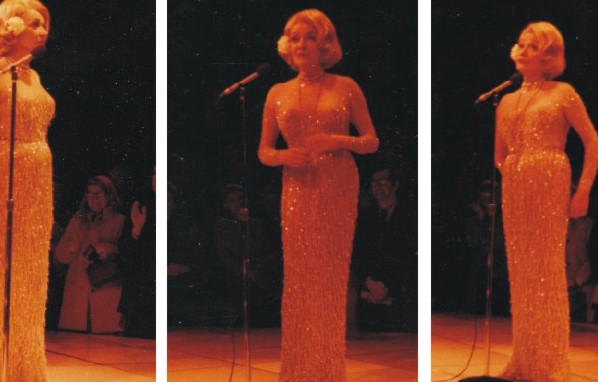
Wearing
that incredible white ermine coat which followed behind her, she
stepped
into her beam and floated down the aisle, looking straight forward,
neither
waiving to the cheering crowd nor acknowledging the standing ovation
they
were giving her. Head high, moving forward, I applauded her and
chuckled
to myself that I was the only one there who knew what was going on in
her
head - she was counting the steps.
On
the twenty-eighth step she started to ascend the “wamp” and the crowd
exploded.
She walked the perimeter of the circular stage so that everyone, as
Ethel
Mertz might say, could get a load of her. She acknowledged Stanley and
stepped to the mike and purred into it as if it were the ear of her
great
paramour.
“I can't give you anything but love, baby.
That's the only thing I've plenty of, baby…”
After
two more songs, the coat came off, the stage turned, she sang two dozen
more songs including “Lili Marlene” and “Falling In Love Again” and
left
them wanting more. The audience stood and screamed.
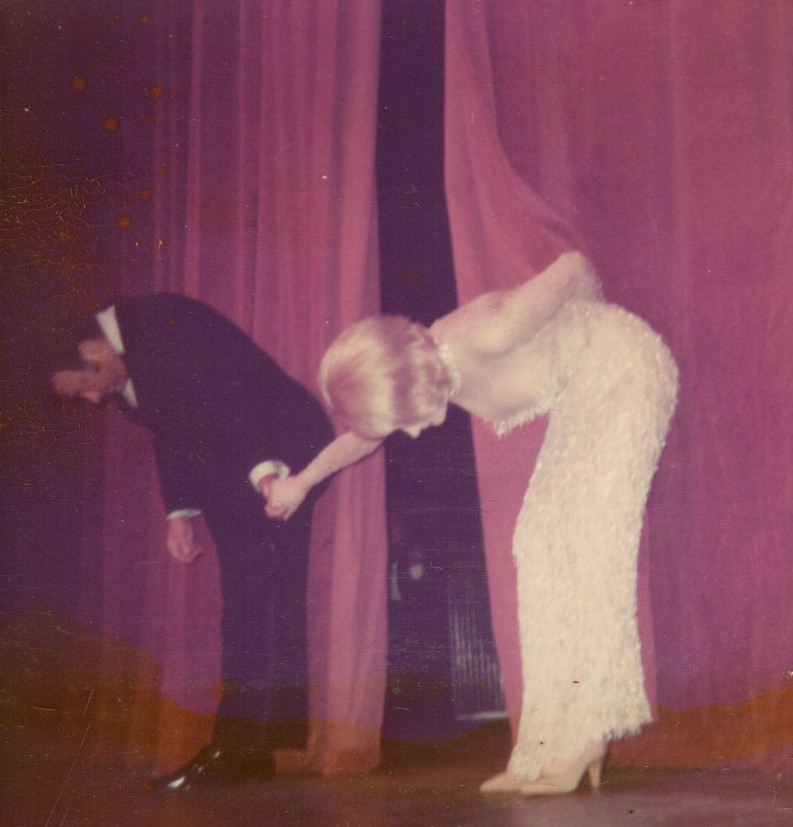
Stan Freeman
bows with Marlene Dietrich at the Queens Theatre, London (1972)
I had
seen this same show twice before Stan and I ever met. Once was in
Montreal
during Expo ‘67 and also when she played the Lunt-Fontanne on Broadway.
I took my cousin Eileen Quain to see it and she begged me to wait with
her so we could get Dietrich’s autograph after the show. We stood
outside
the stage door in three degree weather, right next to the door, and
when
Dietrich came out my cousin thrust her program at her,
“Miss Dietrich, may I please have your autograph?” implored Eileen.
Without
even looking at her Dietrich said “No“ and pushed her way through the
crowd
to her waiting limo. Oh, well. Five years later, I wanted to call
Eileen
and tell her I was sitting with Dietrich in her dressing room after her
show drinking champagne with her but she wouldn’t believe me. I hardly
believed it myself.
“I’m vewy hungwy,” said Marlene, who had now switched to vodka. “We’re
going to the Fisherman. I have a cwaving for soft-shelled cwabs.”
Stanley
bellowed, “How about you, Jim? Some soft shelled crabs and then
scallops
and maybe shrimp cocktail, lobster and shad roe? How does that sound?”
I raised
my glass and returned his toast by sticking out my tongue at him, which
Marlene caught.
“What’s this?”
Stan
explained that he was kidding me because I had an aversion to fish. I
couldn’t
stand the sight of it. Still can’t. I tried to eat tuna salad once and
couldn’t actually come to put it in my mouth before I started gagging.
I know it’s totally psychological. I know it’s totally
irrational.
know I’m depriving myself of some of the greatest culinary pleasures on
earth. But I hate fish and will never eat it.
Stan
finished explaining my “problem” to Marlene and why he was laughing to
Marlene who looked at me very strangely.
“No fish?” she asked.
“No fish,” I echoed.
The
deep seated aversion I had to fish was inexplicable. I had grown
up less than a quarter of a mile from New York Harbor, in Bay Ridge
which
is the section of Brooklyn that anchors the Verrazano Bridge. For the
first
ten years of my life a squat, green ferry crossed the narrows from the
69th street pier in Bay Ridge to Staten Island. The ferry went out of
business
when the bridge was finished in 1964, but the pier at 69th street was a
favorite fishing spot where all the neighbors would go crabbing on the
weekends.
I was
terrified by the sight of these mesh cages filled with living
breathing,
ugly, monstrous crabs. My uncle John would be one of the fisherman from
time to time and would take the crabs out their cages and chase after
with
me aiming the crabs for my throat. I had also just seen “The Creature
From
The Black Lagoon” which didn’t help my paranoia about biting into
things
that lived under the water.
In
the Joan of Arc nursery school one of the teachers tried to convince me
that the tuna salad she was serving me was actually chicken, but after
one taste I knew I had been lied to and became hysterical. Fish and I
would
never come to an easy agreement.
Dietrich
picked up the phone in her dressing room and dialed 411. “Get me The
Fisherman,”
she purred. Obviously the operator didn’t realize it was the great
Marlene
Dietrich when she asked. “What city please?
“I don t know what city, just connect me to The Fisherman. It’s a
westauwant.”
She
held the receiver for a moment while the operator found the number ands
then made the connection.
“Hello, Fisherman?”
I
swear I thought she was going to cut the reservation to 7 instead of 8
and let me sit in the car while they all had dinner. Instead she said,
“This is Marlene Dietrich speaking. I am coming to your westauwant with
a party of 8. One of my guests eats no fish. Does the Fisherman serve
meat?”
It sounded like an oxymoron. A meat-catching fisherman. She listened
for
a moment then nodded as though she understood the answer and hung up.
“There will be no problem. Shall we go?”
It
only took her a few minutes to change into her red pants suit and we
left
by the stage door. There was a crowd of about twenty waiting for an
autograph
or just a close up look at the great star, but she was like a tight end
pushing her way through the people, not stopping, not looking until she
was inside the back of the limo. The rest of us followed her in and
within
a few minutes we were being escorted into The Fisherman. The place
smelled
of fish.
The
maitre’d bowed and led us to a beautifully set round table in the
corner
overlooking
the wharf. Most of the people in her entourage didn’t want to sit next
to her, leaving me next to the legend who still looked like the icon
rather
than the old German lady. As soon as we got settled, Stan Freeman
noticed
a young girl approaching the table. She was heading straight for
Dietrich.
There was another great star eating at the restaurant that night and
she
had sent the girl over to say hello to Marlene on her behalf.
The
girl pulled up right next to Dietrich and said, “Excuse me, Miss
Dietrich.”
Without
turning or looking, Marlene said coldly, “You are not excused.”
The
girl went white but continued with her mission. “But I have regards for
you from Ann Miller. She’s sitting over there.” Dietrich looked across
the room to see Miss Miller waving to her then turned to the girl and
said,
“Ann who?”
“Ann
Miller,” repeated the girl.
“Well,
you are vewy wude. Now please leave this table.”
The
girl, almost in tears, ran back to the Miller table and whispered into
Ann’s ear. Miss Miller shrugged and everything went back to normal.
Stars
and public figures can be funny about fans interrupting their dinner.
There’s
a famous story about Rex Harrison having dinner with Moss Hart at
Sardi’s
between a matinee and evening performance of “My Fair Lady.”
Legend
has it that an elderly woman approached the Great Rex with a program in
hand. “Oh, Mr. Harrison,” she gushed, “you are my most favorite actor
in
the world. I’ve seen every film you’ve ever made I waited a year for
front
row seats to the show and there you were in person and I was breathing
the same air you were breathing and you are so handsome and talented
and
if only you’d sign my program my life would be complete.”
Harrison
turned on the lady and barked, “How dare you, you old biddy. Can’t you
see I’m trying to enjoy my dinner without you prattling on. I don’t
care
who you love or what air you breathe or anything else. You are
disturbing
me.”
With
that, the lady held off, smacked him on the head with her playbill and
walked away. Moss Hart then observed, “Well, that’s the first time I
ever
saw the fan hit the shit.”
I also
saw Pearl Bailey treat a young fan terribly. It was at Sardi’s after a
performance of “Hello, Dolly!” when a small boy of about ten approached
the star at her table. “I saw the show today,” said the lad, “and could
I have your autograph?”
Miss
Bailey sneered at the boy, “Can’t you see I’m eating with my friends.
Hasn’t
your parents taught you any manners? I’ll sign the program when I
finish
eating and you can just stand there until I do.” The boy started to cry
and stood frozen not knowing what to do. His mother ran over and
collected
him while Miss Bailey never looked up again.
The
mood of the dinner changed for the good when Joe Davies, Dietrich’s
lighting
designer, arrived with an early edition of the San Francisco Chronicle
that contained a rave:
Dietrich
and her act are the most remarkable feat of theatrical
engineering
since the invention of the revolving stage, and age has if
anything
reinforced her voice to the point where (for " Lili Marlene” or
Seeger's
"Where Have All the Flowers Gone ?") she seems to have within her the
strength
of entire armies.
While
we sat at dinner, I asked Marlene how Stan had come to be her musical
director.
She told me that when she first put the act together, Bewt Bachwach was
her conductor and friend, but he had tired of doing the show and was
preparing
his first (and only) Broadway musical “Promises, Promises.“ As things
are
meant to happen, Stan was walking down Fifth Avenue one night and ran
into
Bert who said Marlene was looking for a new conductor and he would
recommend
Stanley if he wanted the job.
Bert
warned him that she wasn‘t easy to work with, but Stan couldn‘t pass up
the money and the perks that came along with the job so he took on the
assignment.
The
first few weeks were rocky. Stan said she was impossible to work with
and
found fault with everything he suggested or did. After one performance
in London, Marlene complained about something Stan had done and he hit
the ceiling, calling her every name in the book. He told her she
couldn’t
sing and that she was overrated and a supreme pain in the ass to work
with.
She loved him from then on.
The
outburst did the trick. Marlene cried and said that she couldn’t lose
him
because he was the best conductor she had ever had. They were together
for twelve years until Stanley helped to end her career for good.
They
were performing at the Shady Grove Music Theatre outside Washington,
D.C.
On the first night, all went well except for the curtain call. Marlene
came over to the foot of the stage and reached down to shake Stan’s
hand
after the performance. He said that she had to bend so far that he was
afraid she would fall into the pit.
The
next night, November 14, 1973, the show went along fine - full house,
responsive
crowd and standing ovation at the bow. Stan, being a gentleman, decided
to stand on the piano bench so that Marlene wouldn’t have to reach down
as far to shake his hand. He stood on the bench, took Marlene’s hand,
the
bench broke and he pulled her into the pit. Miss Dietrich landed on the
drums, accompanying her fall with a tremendous, unexpected rim shot.
Blood
poured over her famous gown and it turned out she had gashed her leg
open
as she was impaled on the cymbal.
He
told me that the audience let out a group gasp and an elderly married
couple
who had been sitting in the first row leaned over the orchestra pit
railing
and very nonplused said, “Very nice show.”
An
ambulance took her the then 72 year-old to the local hospital where she
was stitched up but the doctor found it difficult to close the whole
wound
which was about four inches in diameter. Senator Ted Kennedy sent his
own
personal physician to assess her condition and he told her that she
lost
a great deal of skin which had been sliced off by the edge of the drum
kit.
Stan
visited her in the hospital and was truly heartbroken that he had been
the cause of her troubles. She said she didn’t blame him. It was an
accident
and accidents happen. Though she did mention that the pain was
unbearable
and she would have to go through months of skin grafts and physical
therapy.
She added that the doctors weren’t sure if the wound would ever heal or
that she would ever walk properly again but that Stan shouldn't give it
a second thought because it wasn’t his fault - though if he hadn't
gotten
on the bench, the accident wouldn’t have happened.
For
weeks after the accident, Marlene would send pictures of her leg with
horrific
pictures of her wound - before and after the skin grafts - and then
with
huge bandages that covered her legendary leg from ankle to knee. With
each
note and each picture, Dietrich underscored that it wasn’t his fault
and
he shouldn't feel guilty.
She
performed two weeks later in Toronto against her doctor’s wishes where
she saw no one outside of her group, traveled by freight elevator
between
her room and the stage and played the entire two hour show in enormous
pain. Her leg would not heal if she kept up the schedule so she knew
she
had to tend to her leg or it would be amputated. The leg that once had
been insured by Lloyds of London.
After
Toronto, she returned to her apartment in Paris where Stan would call
her
from time to time to cheer her up. Marlene always answered the phone
herself
but insisted she was the maid and that Miss Dietrich couldn’t come to
the
phone but she would pass on his good wishes.
Dietrich
eventually went back to work after about nine months of recuperation
and
brought Stan back to conduct for her. But she wasn’t the same. She was
brittle and in pain while she performed and took to using a stool so
that
she wouldn’t have to stand. Even the potassium from the bananas
couldn’t
help.
On
October 4, 1975, while she was performing in Sydney, Australia she fell
again without any help from Stanley and broke her leg. That was the end
of her career. She never performed again and she retired to her Paris
apartment,
a place she never left until she was carried out in feet first in 1994.
June
20, 1959 - New York City
How
does a kid from the Bay Ridge section of Brooklyn go into show business
and get to watch Marlene Dietrich rehearse when all he ever wanted to
be
was a priest. I was born on August 16, 1946 in the first year of
the baby boom, the second year of the Truman presidency, the third
printing
of Dr. Spock’s The Common Sense Book of Baby and Child Care,
the
fourth sold-out month of Annie get Your Gun and the fifth week
that
Chiquita
Banana tied with Zip-a-de-Doodah in the top slot on Your
Hit
Parade.
Just
about everyone in my family - mother, father, grandmother, grandfather,
uncle and some cousins were born in August which led me to believe that
the Brochu-Condon-Ryan-Morrissey clans only had sex at Thanksgiving
whether
they wanted to or not. They were all so logy from all that turkey
that they fell into bed and did what came naturally.
My
father’s side of the family came from French Canada by way of upstate
New
York and settled in Washington Heights just south of the George
Washington
Bridge. My mother’s folks were from Ireland and settled in what was
then
called the Fourth Ward of New York Cty's lower Manhattan, an area along
the East River just South of the Brooklyn Bridge. My mother,
Veronica,
was an only child, the daughter of Dick Condon and Theresa Morrissey:
my
father - son of Joseph Brochu and Mary Ryan - was the oldest of three
boys
and a girl who died of cholera when she was four.
Mom
met dad when she worked in the steno pool for the Wall Street brokerage
firm Allen and Company where dad was an up and coming executive. He
started
as a runner there in 1933 where the patriarch of the Allen clan,
Charles
Allen, saw potential in my father and promoted him to Municipal Bond
trader.
He became enormously successful by raising bond revenues for projects
such
as the Mackinac Bridge in Michigan, the Brooklyn Battery Tunnel and the
Verrazano Narrows Bridge.
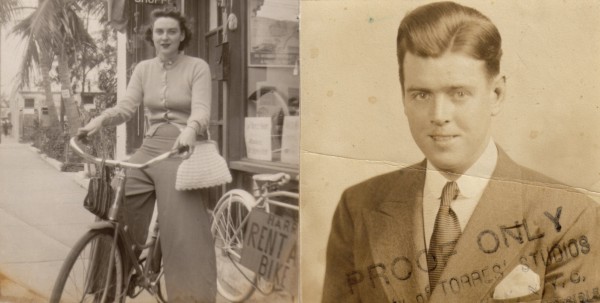
Mother Vera,
age 25 (1944) and a proof of Dad, Pete, age 25 (1937)
Mother
was, as my father described her, a “classy broad” who look like Merle
Oberon
and enjoyed a dirty joke with the best of them. They were engaged in
1937
but didn’t marry until 1943 while dad was on leave from his navy duty
in
the South Pacific. They pulled the wedding together in five days. My
mother
was never a well woman, having fought a bout of rheumatic fever when
she
was a child that left her heart weak. She died on Father's Day, 1949 at
the age of 29 when I was three years old.
My
father’s widowed mother moved to Brooklyn with her youngest son, my
Uncle
John, to live with us in Bay Ridge. The last thing a 60 year old woman
wanted to do was take care of a three year old boy, but she made the
sacrifice.
The only thing she and my mother’s mother Tess who I called "Ma" but
everyone
else referred to as "The Chief" had in common was their devotion to the
Catholic Church and the opportunity to mold me into being a priest. And
it almost worked.
Like
a career, I started as an altar boy and worked my way up to being our
pastor,
Bishop Edmond J. Reilly’s personal altar boy. The Bishop formed an
alliance
with my grandmothers by giving me the prime daily masses and making
sure
I watched Bishop Fulton J. Sheen instead of Milton Berle on Tuesday
nights
at nine. In fact when Bishop Reilly died in 1958, Bishop Sheen came to
Our Lady of Angeles in Bay Ridge to deliver the eulogy and I was
assigned
to carry his bags. Sheen was one of my idols but at age 12, I was
already
a few inches taller than the charismatic though diminutive evangelist.
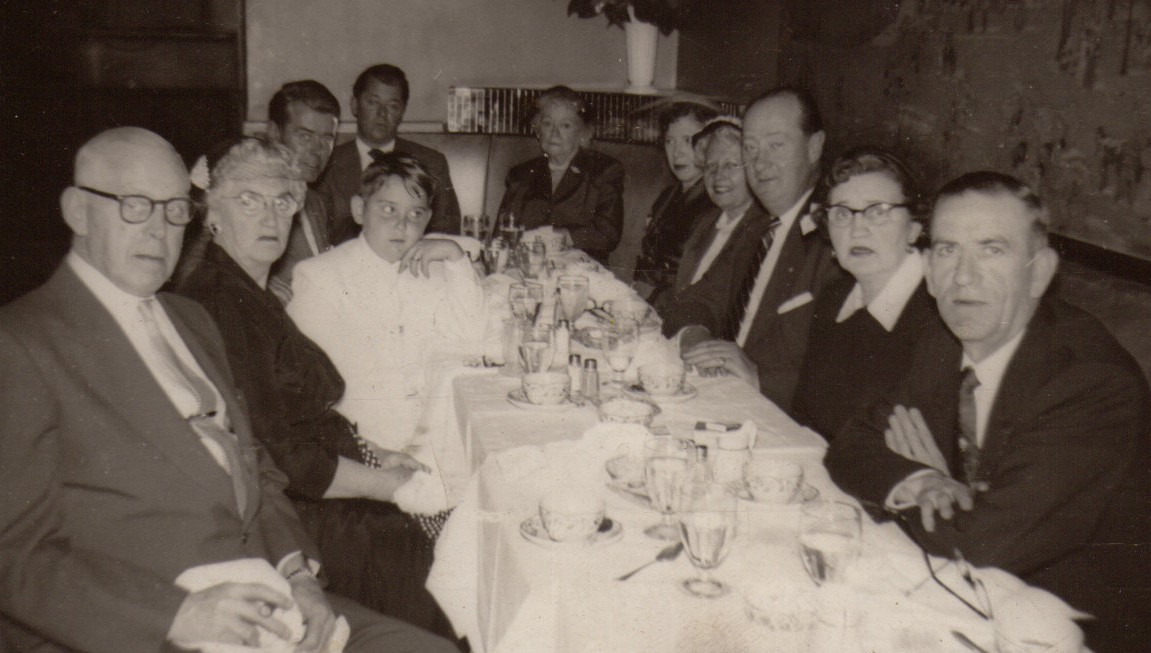
The Brochu-Condon-Morrissey
Clan at my First Communion.
(l. to r.) Pa
and Ma Condon, Jim, Dad, Uncle John, Nana, Aunt Helen Quain,
Aunt Betty Morrissey,
Uncle Eddie and Aunt Jo Nash, Uncle Bobby Morrissey.
(How come nobody
looks happy?)
A few
months before Bishop Reilly died, I asked my father if we could go to
Europe
for the 100th anniversary of the Lourdes apparitions. I had seen “The
Song
of Bernadette” many times and wanted to see the locations for myself.
Dad
agreed, giving me many perks since I was an only child without a mother
and booked an entire “Catholic Pilgrimage” of Europe which included all
the great shrines of London, Paris, Brussels and Rome. The first stop
was
Shannon Ireland where I stopped the immigration process cold by stating
my profession as altar boy. There were two priest-chaplains named
Hewitt
who were real-life brothers from Tom’s River, New Jersey. They also saw
me as a future priest and bought me a black priest’s biretta which I
wore
all through the trip.
In
Lourdes, I expected to see a full blown miracle only to witness a sick
man fall out of his wheel chair and crack his head on the cement. The
viewing
of the mummified body of St. Bernadette proved more creepy than
inspiring
and the home in which she lived was far more upscale than the dank
prison
portrayed in the film.
The
pinnacle of the trip came in Rome where we attended an audience of Pope
Pius XII’s and I stood close enough to almost touch him. The presence
of
this living saint was marred when he opened his mouth to bless the
crowd
and he sounded like Gracie Allen with a bad Italian accent.
In
Paris, we visited every church in the city and met a Bishop Boardman
from
Brooklyn, who as fate would have it, would become my pastor after the
death
of Bishop Reilly. Boardman was a ruddy-faced politician who could have
been cast as a Senator as much as a prelate. When he did become our
pastor,
my father reintroduced himself and reminded the Bishop that we had met
and spent time with him in Paris only a few months before. Boardman,
ever
the glad-hander said, “Of course I remember you. I remember you very
well.
And how’s your lovely wife?” “Dead,” answered my father, “for ten
years.”
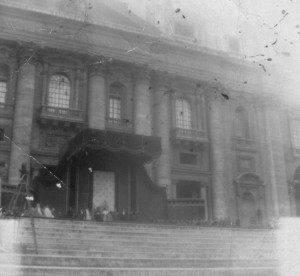
Pius XII's Audience
in St. Peter's Square (1958)
Yes,
as I entered the seventh grade it was all but decided that I would
enroll
in the minor seminary after graduation and take the first steps on my
sacred
path to being the first Brooklyn-born pope. And then my grandfather
bought
me a record player and that path was forever detoured. Pa, my
mother's
father, had bought the record player because I told everyone who
would listen that I had sent away for a record album of Pope Pius XII
singing
Gregorian chant but had nothing to play it on. The record player
arrived
before the pope’s LP and so I went to the record store and picked up
the
first album I saw - Ethel Merman in Annie Get Your Gun.
I raced
home to test the sound of my new phonograph and heard my first
overture.
Then came the voice of Merman. Oh that voice. Oh my God, that voice.
She
sang “Doing What Comes Naturally.” Before I got to the next track, I
replaced
the needle and played it again. And again. Within a half hour I knew
every
word. My grandmother who lived with me, who we called Nana, was going
out
of her mind. Finally she came into the bedroom I shared with her and
said,
“Turn that screech owl off!”
“Don’t you like her?” I wanted to know.
“No, she’s a loudmouth multi-divorcee,” came the reply.
I didn’t
know why my Nana had linked her singing power to her marriages and
didn’t
care about the connection. All I knew was that the voice inhabited
every
fiber of my body and perhaps had taken over my soul. After my
grandmother
went to sleep, I took the record player out to the living room and
listen
to the album all over again with my ear pressed against the speaker,
the
volume almost inaudible. My father came home with a half snootful, as
usual,
as asked me what I was listening to. Thinking it was permission,
I turned the volume up full and Merman’s voice inhabited the room. Dad
started singing along with her to “There’s no Business Like Show
Business”
and then said,“What a great show!”
“You
saw her?”
Came
the incredible response, “Saw her - I know her!”
“What do you mean you know her?”
“Her dad is the CPA for my company. Ed Zimmermann. He’s one of my best
friends.”
“Did you ever meet her?”
“Of course I’ve met her. I see her all the time when she comes down to
have lunch with Ed. I’ve even taken her out to dinner a few times.”
“Will she be my new mother?” I wanted to know.
“I don’t think so,” he said, “She’s married to the head of
Continental
Airlines. We’re not in the same league.”
“What does that mean, daddy?”
“It means I couldn’t afford her.”
“Nana hates her voice.” I offered.
“Well, she should hear her sing in person.”
“I want to hear her sing in person,” I said almost jumping up and down.
“Where does she sing?”
“She sings on Broadway. She’s in Gypsy.”
For
a moment, “in Gypsy” sounded like one word and very Latin - like the
pope
making a pronouncement “Ingipsie.”
“Can
we go see it?” I begged.
“I
don’t think you’re old enough.”
The
noise had awakened my grandmother who stood in the hall just in time to
hear me say, “But you took me to see naked women when we went to Paris
last year.” My Uncle John, the original couch potato, was suddenly
interested.
Nana
choked, “Naked women?! What are you talking about. What naked women?
What
is he talking about, Pierre?”
Though
my father was named Peter, Nana thought Pierre was a better first name
to go with our French Canadian surname. My father had learned to defend
himself all through grammar and high school every time one of the
toughs
yelled “Hey pee-in-the-ear” and dad almost killed my grandmother when
he
went to get his working papers and saw on his birth certificate that he
had been christened Peter., not Pierre.
“It was a harmless little nightclub,” my father tried to explain.
“With naked women? Jimmy, go to bed. Your father and I need to have a
good
talk.”
I did
as I was told and from the bedroom I could hear the argument continue.
While we were in Paris, dad had taken me to a smoke filled basement
dive
where a dozen women came on a small stage and took off all their
clothes.
I wasn’t sure about what was happening since the first one came out
dressed
in a cowgirl outfit looking very much like Dale Evans. It was the first
time I ever saw - as my father called them - “jugs” up close and
personal.
I was twelve, preferred looking at men, and yet I found myself with a
strange
tumescence.
Outside
in the living room, dad was trying to be respectful of his mother. He
tried
to explain that we had gotten there by accident because the joint was
next
to a church. I guess he didn’t see the huge neon sign that kept
flashing
on and off reading, “Le Club Sexy.” After a few minutes more, I
heard
him say to her, “Oh, be quiet and go to bed.“ Nana came in seconds
later.
I pretended to snore so that the conversation wouldn’t continue and I
wouldn‘t
have to answer any questions.
I called
my father at his office the next day and told him he had promised me to
take me to see Gypsy. I knew he wouldn’t remember. I had often used
that
trick to get what I wanted - knowing dad would never remember because
he
was sloshed the night before. “Okay, I’ll call Ed and get Ethel’s house
seats for the Saturday matinee - June 20th at 2:30 p.m.
Dad
invited my grandmother and Uncle John to go with us, but she invoked
the
Legion of Decency which had condemned the musical as being too prurient
for any catholic of any age to see. She would not go and she would not
permit her youngest child to go, even though he was 36 years old.
My
father gave the other tickets away to two actor friends of his, Matt
Tobin
and Otto “Babe” Lohmann. Ed Zimmermann, Ethel’s father met us in front
of the Broadway Theatre on West 53rd Street and handed us the tickets -
Ethel Merman’s own house seats, E 101-104. I sat on the aisle.
I had
actually seen one other Broadway show - a straight play - when I was
11,
do to my love of science fiction. I was home sick from school one day
when
I watched an afternoon interview show featuring an appearance by Cyril
Ritchard. Ritchard had played Captain Hook brilliantly in the
television
presentation of Peter Pan opposite Mary Martin, but now he was
promoting
a show called Visit To A Small Planet by Gore Vidal. I loved
anything
that had to do with space travel and so when my father came home, I
asked
him to take me to see it. He didn’t make the connection with science
fiction,
only proud that his eleven-year-old son wanted to see a Gore Vidal play.
The
show was at the Booth Theatre and I did not expect the lights to go
down
and to be in the dark before the curtain went up. I expected a
planetarium
show, but when the curtain rose we were in a suburban living room with
very earthly characters whose every other word was “bastard’ or” son of
a bitch. My grandmother, sitting next to me, jumped every time and
epithet
was uttered. The whole experience enchanted me but didn’t prepare
me for the transforming experience that was Ethel Merman in Gypsy.
As
we took our seats in the front row and listened as the orchestra tuned
up, there was a buzz of excitement that filled the theatre. It was like
church but with energy. The overture began, the trumpets blared, the
curtain
went up and Ethel Merman swept down the aisle right next to me
shouting,
“Sing out, Louise! Smile, baby!” By the time two hours had passed, I
experienced
a religious conversion the likes of which I had never felt in Lourdes
or
Rome. Visit To A Small Planet had been a three act play and I was
shattered
that the cast started taking its bows only after two acts. I didn’t
want
it to be over. It had to go on forever. And even though the show
had been condemned by the Legion of Decency for some inexplicable
reason,
the girls in the burlesque scenes still wore scads more than those at
Le
Club Sexy.
When
the house lights came on, my shaky legs barely got me out of my seat
and
carried me around the corner to the stage door where we were going to
meet
Mr. Zimmermann. He would then take us through to the backstage to meet
his daughter. The doorman told us that Miss Merman was on the stage -
waiting
for us. We could go right out. It was like walking onto holy ground.
She
was still in the same lavender dress she wore for Rose’s Turn, the
electrifying
finale of the show.
“Hiya,
pop!” said Ethel as she greeted her dad. “Hiya, Pete,” she said as she
gave my dad a kiss on the cheek. “And this must be Jimmy.”
Oh
my God, she knew my name. I could feel the stage hands swirling around
us putting the sets in order for the evening show but I couldn’t take
my
eyes off of Merman. My first thought was that she was taller than
Bishop
Sheen.
She
must have thought me to be an idiot because I couldn’t answer any of
her
questions. “Did you like the show?” “How were the seats?” “Have you
seen
a Broadway show before?” “What grade are you in?” And then, the curtain
of the Broadway Theatre went up and I looked out into the house with
its
rows of blue and gold seats and huge windows on either side of the
stage.
Then
came the question from Merman, “So what do you want to be when you grow
up?” I always had a ready answer to that question which I had been
asked
hundreds of times, “I’m going to be a priest.” But this time, I had no
answer except to stare into the empty Broadway Theatre and mumble,
“This!”
The
course of my life was forever changed that day. The road to Rome became
the road to Broadway and worship of the Virgin Mary was transferred to
the great Merm. I ended up seeing Gypsy a dozen times over the almost
two
years it played on Broadway and saw Merman every time after. She always
greeted me warmly. Always had time.
A few
years later, we had dinner with Ethel and her parents, Ed and Agnes, at
Toots Shor’s Restaurant on West 52nd Street. It was a sad dinner
because
Ed was going blind and Ethel had to cut his meat for him and help move
his food around the plate to find the pieces. Ed started crying, not
wanting
to be a burden to his family. He couldn’t work anymore because he
couldn’t
see the numbers in front of him - rendering him useless as a CPA.This
realization
seemed to hit at dinner with his daughter cutting his meat for him and
little Agnes holding back the tears watching.
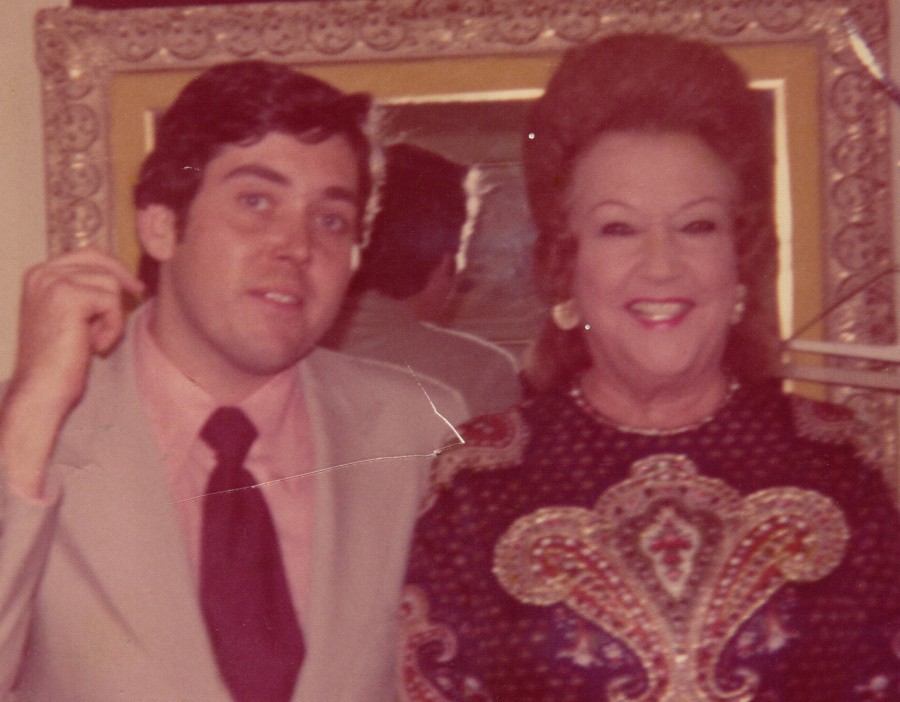
Ethel
Merman and Me (1976)
Some
twenty years later, in 1981, I worked with Merman and cried when
I realized that she had experienced some kind of brain meltdown when
she
couldn’t remember the lyrics to a song she introduced in the 1930s. I
called
my friend Stan Freeman who had conducted for Ethel often and told him
about
the incident she had at the taping. “Getting old isn’t pretty,” he
said.
“If I ever get to that point, I think I’ll just end it all.” In January
of 2001, he did just that.
Stan
Freeman was my best friend for thirty years and I learned that one of
the
reasons Stanley was not a well-known name except for show business
circles
was that he did too many things too well. I believe Stan was one of the
greatest piano players of the 20th Century. His most famous gig was
playing
the harpsichord on the Rosie Clooney recording of “Come On A My House.“
He composed two Broadway shows. The first was” I Had A Ball” in 1964
with
Buddy Hackett which was a moderate success and in 1970, “Lovely Ladies,
Kind Gentlemen” which was one of the best known flops in the history of
Broadway.
Clive
Barnes review of the show caused the cast to picket him and the New
York
Times
when he wrote a scathing assessment of the musical beginning with “I
come
not to praise Lovely Ladies, but to bury it!” And he did. The show
which
starred Ken Nelson, Ron Hussman and David Burns, closed after limping
along
for two weeks.
The
funny thing about “Lovely Ladies” is that it wasn’t a bad show. Those
who
saw the show enjoyed it very much. It was not the greatest musical
ever,
but certainly not worthy of Barnes’s scorn. It was the wrong show for
the
wrong time. Nobody wanted to see the musical version of Teahouse of the
August Moon, about soldiers occupying the Japanese island of Okinawa,
while
the Vietnam war was raging on. All-Singing, All-Dancing Asians (played
by whites) wasn’t what the Broadway audiences were craving in 1971. But
I saw almost every one of the 16 performances because one of the stars
of the show was the man I loved. I had always been looking for another
mother, but in David Burns I found another father. I was holding out
for
Joan Crawford to be my mommie, dearest.
And
then came Crawford!
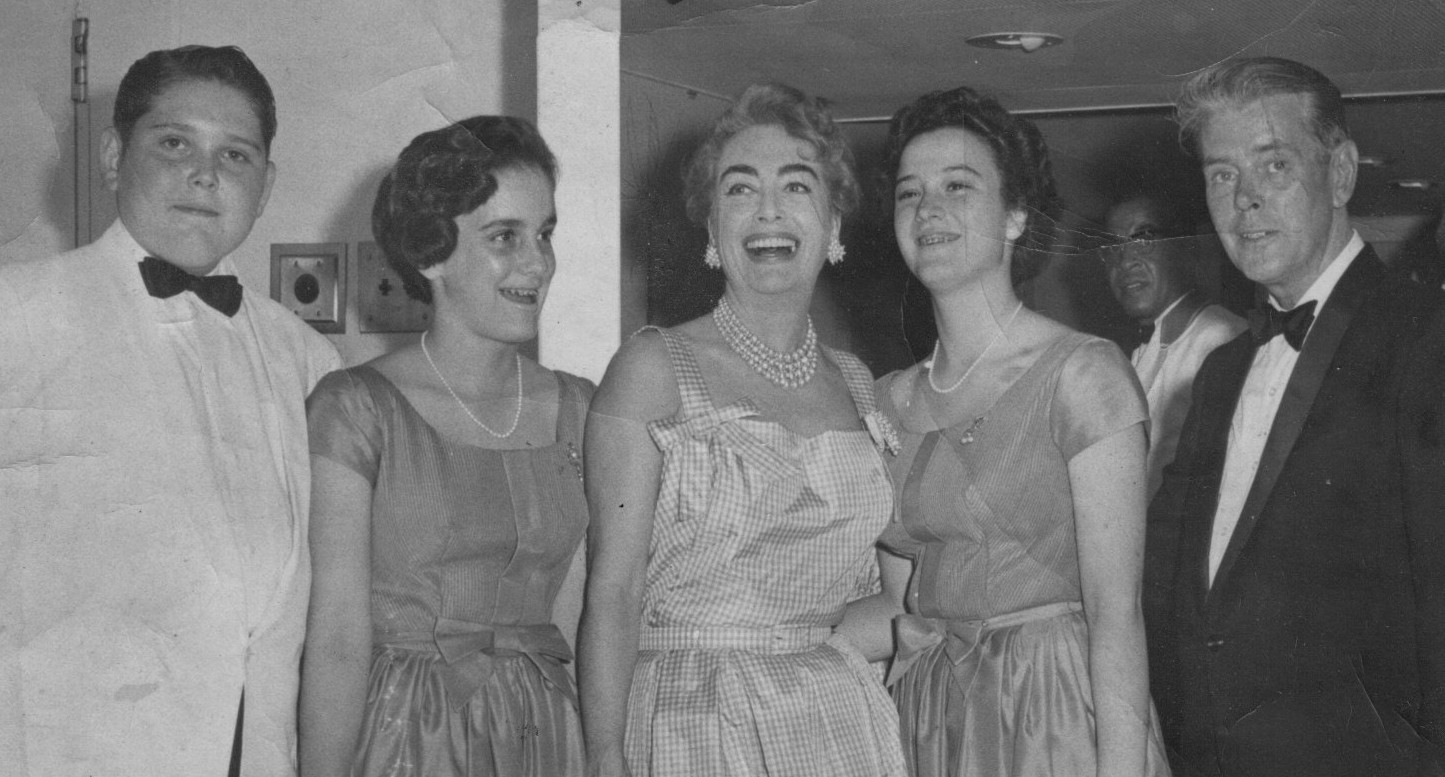
Me, Cathy Crawford,
Joan Crawford, Cindy Crawford, Dad
Bio
| Résumé | Current
Appearances | Video Clips | Lectures
| Jim's Books and Plays | Press
and Reviews |
Photo
Gallery | The Last Session
Homepage | The Big Voice: God
or Merman? Homepage | Contact
CHAPTER TWO: Latitudes and Attitudes
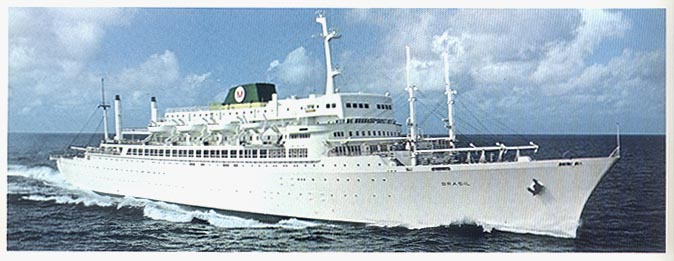
<><>July 1, 1960 - En Route to Rio De
Janeiro<>
Just
as our Bon Voyage party on the S.S. Brasil was peaking, dad’s
drinking buddy, Bill King, came lurching into the cabin to announce
that Joan Crawford had
booked space somewhere on the ship and was sailing with us. I had
no idea who Joan Crawford was but
everyone in the room was thrilled about it. Mr. King, who was
absolutely
bombed, suggested we go to Crawford’s stateroom and introduce
ourselves. I was
trying to keep an eye on my grandfather, Dick Condon, who was also on
his way
to total oblivion since he wouldn’t relinquish his seat in our cabin
and the other paartygoers kept
pouring scotch down his throat.
Dad
told me Joan Crawford was one of the greatest movie stars of all time -
an
Oscar winner - and suddenly I was interested. We formed a small welcome
aboard
committee, went down to the public room where Miss Crawford’s bon
voyage party
was in full swing and knocked on the door. After a moment, the door
opened and
there stood a beautiful lady in a black and white polka dot dress with
a huge
black picture hat framing her red hair.
I
only got a glimpse of her before Bill King stepped in front of me and
said,
“Miss Crawford, my friends are sailing with you and I just wanted you
to meet
them.” Joan said a hello to no one in particular and started to close
the door
as Bill King put one foot inside and said, “Miss Crawford, may I kiss
you.”
Without seeing the reaction on her face, all I heard was a soft, sweet
“No” as
the door closed. We went back to our party.
One
of the saddest things about the takeover of the terrorists these days
is the
demise of the bon voyage party on the great ships. Back in the sixties,
anyone
was welcomed aboard to celebrate the departure of their friends on an
ocean
voyage. For a fifty cent contribution to the Norwegian Seamen’s Fund,
the ship
was open to all visitors. Dad decided that we would go on a cruise the
summer
before I was shipped off to Military school.
The
S.S. Brasil was the flagship of the Moore-McCormack Lines
which was half
freighter and half luxury passenger ship that made monthly voyages
between New
York and Buenos Aires with stops in Barbados, Caracas, Trinidad, Sao
Paulo, Rio
de Janeiro and Montevideo. Joan was not the only celebrity aboard. The
great theatrical
caricaturist Al Hirschfeld was also sailing with his wife, Dolly, and
daughter,
Nina, who he immortalized by placing her name in all of his artwork.
But Joan
Crawford was the only person my father wanted to get to know. And he
did.
Biblically.
The
announcement blasted through the stateroom, “All ashore that’s going
ashore.”
My grandfather tried to stand but couldn’t. The fourteen scotches he
put down
during the soiree had robbed him of his power of locomotion.
My
mother’s father was a fascinating man who started out as a fireman in
New York
City when horses drew the trucks through the streets. He won the James
Gordon
Bennett Medal for heroism, the highest honor the
Department could bestow on any of its fireman because he saved ten lives
during the infamous Triangle Shirt
Factory Fire in 191 But as we were preparing to sail, he was
sloshed and
incapable of movement. We propped him up against the door of the
stateroom and
told him to stand there as we found his hat and coat. When we turned
around, he
was gone.
We
panicked because the ship was about to sail and Pa (as we called him)
was gone.
Not in the passageway. Not in the elevators. Not on the decks.
Vanished. Dad
was about to make arrangements for him to go all the way to Rio with
us. The
Promenade Deck was lined with partying passengers, throwing streamers
and
confetti to their friends on the shore. We looked down the pier to see
if we
spotted Pa but he was nowhere to be seen. Then, as I looked down to an
opening
in the hull on the lower part of the ship where there was a conveyer
belt
bringing food on. It suddenly stopped and began rotating the other way
toward
the dock. Pa appeared on the conveyer belt supported by two crew
members
holding him under both arms and was rolled off to shore.
The
Brasil pulled out into New York harbor and began slowly
sailing down the
Hudson into the Narrows and passed the apartment house in which we
lived. We
didn’t sail under the Verrazano Narrows Bridge because it had not yet
been
built. I felt so lucky to live right on the Bay and I loved ships more
than
anything in the world. I would run to the roof early in the morning to
see the
new ships sail into the harbor on their inaugural call to New York, greeted by the fire boats spraying them with
a rainbow-infused welcome. I even watched the Stockholm limp
into the
harbor the day after it rammed the side of the Andrea Doria and
sank it.
The sight of the ship with its bow seared off was chilling, especially
after
watching the footage of the great Italian liner sink the night before.
The
first day at sea on the Brasil there was a mixer for all the
teenagers
on board so I went and met twin girls named Cindy and Cathy who were
exactly my
age . The cruise director, Danny Leone, hosted the party which lasted a
few
hours and made sure we knew the names of all the others kids our age on
board.
When the party was over, Cindy and Cathy invited me back to their cabin
to play
board games and I accepted. They wanted me to meet their mother, who
was
recently widowed. Always on the lookout for a new mother, I thought,
“Why not?”
When
we came into the cabin, their mother was sitting at the vanity table
dying her
hair. She greeted us all with a smile and welcomed a game of Scrabble
on the
stateroom floor. Within an hour, I knew I had found my perfect
stepmother along
with two built in stepsisters.
My
father didn’t want any part of it.
“But
daddy, she’s really beautiful!”
“I
know a lot of beautiful women,” he snarled.
“And
she’s a widow.”
“I
don’t want to meet any widows,” he confirmed. “And I don’t want to get
married
again. I’m not getting married again. So don’t do any matchmaking
because
you’re just wasting your time.”
Back
in the sixties, every night aboard a ship was a formal night with the
ladies in
elegant gowns and the men in tuxes. I always thought the guys had it
easy
because the tux was like a uniform - you didn’t have to decide what to
wear - a
tux was a tux - unless you had a white dinner jacket and then you had
to
decide.
Dad
dressed early and looked like a movie star in his formal clothes. He
went to
the Captain’s “Welcome Aboard” cocktail party early in hope that his
favorite
movie star would show up and he could wangle an invitation for a dance.
Alas, she was a no
show. I still hadn’t made the connection that Cindy and Cathy’s mom
with whom I
had spent the afternoon was Joan Crawford. When the waiter came in to
deliver
her ice bucket he only addressed her as “Mrs. Steele.”
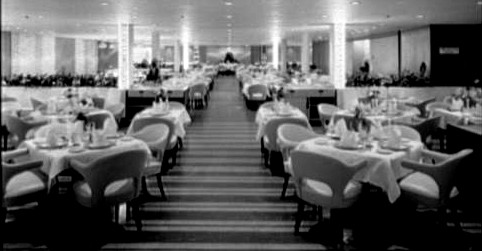
The Dining Room on
the Brasil. This was Joan's
runway to make an entrance.
Our
table in the dining room of the Brasil was all the way at the
back - a
table for two against the wall. Just after dad had ordered his cocktail
and I
was pondering a double order of mashed potatoes, a smattering of
applause began
to sound at the entrance to the room. The applause grew to a roar and
then a
standing ovation by everyone in the room. Dad saw her at a distance and
almost
spit out his Chivas.
“There
she is. Omigod. There she is. Isn’t she beautiful? God, she looks
great. Should
I go say hello. No. I’ll meet her later.”
Although
her table was
next to the Captain’s she kept coming right toward us. Dad looked
behind him to
see who she was looking at only to come face to face with the wall.
When he
turned back, she was standing right in front of us beaming, Cindy and
Cathy
demurely and properly behind her.
“Jimmy,
dear!” she started. “Don’t you look handsome in your dinner jacket?
Thank you
so much for spending the afternoon with us. What a good Scrabble player
you
are.” I looked to dad whose jaw was lying on the salad plate.
“And
this must be Pete,” she continued. “I’ve been hearing a lot about you.
Since
you work on Wall street, I’m sure we have many friends in common - and
we have
a whole month together to find out. Shall we have a cocktail after
dinner…and a
dance perhaps?”
If
you were to open a dictionary at that moment and look up the word speechless,
you would find a picture of my father. He could barely utter a sound as
he
shook her outstretched hand and nodded. The girls also put their white
gloved
hands out but my father never took his eyes off Joan as he shook them.
Even
tough I was only 13, I could not help but notice that there was a spark
between
the two of them. Joan looked back over her shoulder as the maitre’ d
led them
to their own table and she gave dad a wink which had the effect of
having his
legs pulled out from under him.
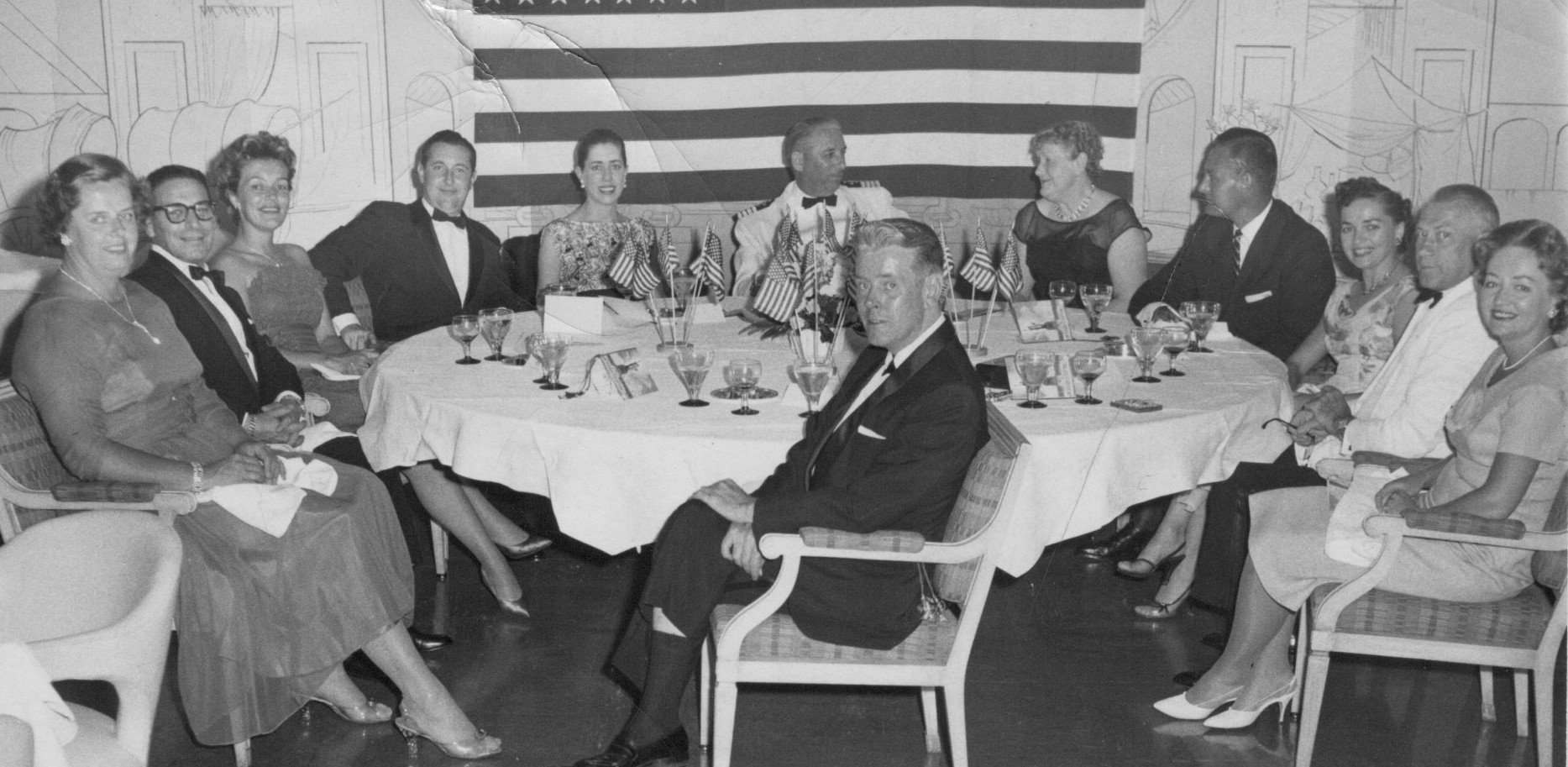
Dad in the foreground having dinner at
the Captains’s table on the S.S. Brasil
Knowing
Joan was experiencing my
first taste of what it was like to be a star.
On the cruise down the East Coast of South America, we made
stops at Sao
Paulo, Rio De Janeiro, Montevideo and Buenos Aires and at every port
the piers
were jammed with local residents trying to get just a glimpse of the
great
Crawford. The turnout was massive. Joan was there on Pepsi business and
scheduled a press conference for every stop. I couldn’t imagine how
many
steamer trunks she had brought since there was a new outfit for every
city, a
different dress for every day and she never wore the same evening gown
twice in thirty days.
On
the third night of the trip, my father did not come back to the cabin
until
morning. He woke me up at seven a.m. trying not to wake me up. I told
him I was
worried and went looking for him about three a.m. He told me he was
spending
time with a new friend. A few hours later, I ran into Cindy and Cathy.
They
couldn’t help me since their mother had a private bedroom in the suite.
Dad
didn’t show up for several nights and years later - after they stopped
seeing
each other and I was old enough to understand - he admitted to a torrid
affair
that lasted years after the ship returned to port.
After
Whatever Happened To Baby Jane? was released, I went to see
the film
with my best buddy from grammar school, Joey Maresca. I kept telling
Joey that
the woman who played Blanche was my friend and though he knew I had met
her on
the Brasil several years before, refused to believe that she
was indeed
my “friend.” Joan lived at 2 East 70th Street at the corner
of Fifth
Avenue which wasn’t far from where we had seen the film.
“If
you know her so well,” he challenged, “let’s go visit her.”
“Okay,”
said I, “Let’s go.”
It
was the middle of our Easter vacation and we were dressed, as my
grandmother
would say, ragamuffins. We got to the apartment door where the doorman
looked
down his nose at us and silently implied to just keep walking. Instead,
we went
up to him and I said, “We’d like to see Mrs. Steele please.”
“She
not home,” he barked.
“She
expecting us,” I lied. “And if she’s not home, Cindy and Cathy will be.”
He
looked at us quizzically, cocking his head to the side somewhat like a
beagle
that had heard a high frequency sound, and went inside. We could see
him on the
phone as he looked back and forth before returning with a somewhat
smile
drooping under his nose.
“She
said you could go right up.”
Joey
looked as astonished as the doorman as we were escorted - not to the
main
elevator - but to the service elevator in the rear of the lobby.
Joan’s
faithful housekeeper,
affectionately known as Mamacita was standing in the kitchen as the
elevator
door opened onto the small service hallway.
“Jeeeemy!”
she bellowed, enveloping me in her endless arms, “Missus is waiting for
you.
And the girls are here!” Then she added, “You know what to do!” Indeed
I did.
Before you could enter Joan’s apartment, you had to take off your shoes
to
prevent any outside dirt from creeping onto her pure white carpets.
Things got
off to a rocky start when Joey protested. I told him that was as far as
he went
if he didn’t. I couldn’t blame him. He shed his shoes to reveal a huge
hole as
with his big right toe sticking through it.
Mamacita
escorted us through the immaculate white living room into the
den/office where
Joan stood behind her desk, framed by a large picture window
overlooking Fifth
Avenue and Central Park. Cindy and Cathy sat on couches on either side
of the
room, giving the impression that the scene had been staged. The girls
were in
matching pink sun dresses and Joan was put together as though the
director was
about to shout, “Action!”
Joan
came around the desk and kissed me on each cheek. Cindy and Cathy
followed
suit. Joey was dumbstruck. The person we had just seen in Baby Jane
was
standing in front of him live and in person. Joan couldn’t have more
gracious
or welcoming, despite the fact that we were there uninvited.
“Thank
you so much for stopping by. The girls are home for Easter and you were
so kind
to think of us.”
“Joan,”
I started, “this is Joey Maresca. We just saw Whatever Happened to
Baby Jane?”
“I
hope you enjoyed it,” she smiled.
“It
was great,” we both stammered.
“Can
I offer you something to drink?”
Joey
answered first. It was an answer that sent chills down my spine.
“I’ll
have a coke,” he said.
The
girls’ eyes widened and they both looked at their Pepsi-wielding mother
for
guidance. Joan’s smile was implacable.
“I’m
so sorry, Joseph” she offered. “We don’t serve Coke here. Wouldn’t you
like a
Pepsi?”
Joey
winced. “No, I don’t like Pepsi!”
Cathy
actually gasped audibly but Joan continued to smile. “You don’t?”
“No,”
he said, “It’s too sweet!”
Still
smiling, albeit now a frozen smile, she offered a glass of water.
The
affair Joan had with my dad lasted about a year but my friendship with
Joan
endured until she died. From time to time, I would go up to the
apartment and
“hang” with Joan, still looking for the mother I had never known. Once
I went
to see her and this time she was actually expecting me. I even got to
go up via
the front elevator. When the door opened onto the foyer into the living
room, a
little old lady in a pink housecoat and babushka was waiting for me. I
said,
“Hi, I’m here to see Joan.” She stared at me with a half-smile,
half-frown and
said, “I don’t look that bad, do I?” We went into the kitchen
where she
was making bouillabaisse for a dinner party the next night - chain
smoking and
sipping vodka. The television was on in the background and a pizza
commercial
came on.
“What
fun it would be to just go out for a pizza.“ she sighed.
“Come
on, “ I said. “Let’s go for a pizza!“
“I
can’t. It would take me an hour to get ready.“
I
know I looked at her not understanding because she continued, “Don’t
you know I
can’t leave this house unless I’m Joan Crawford - and besides, you
don’t need a
pizza.”
Years
later, I became very close with Lucille Ball, who was just the
opposite. If the
urge for a pizza came over her, she would throw on some lipstick and
out the
door we’d go.
From
the very first time I met Joan she was on me from the start that I was
way too
fat and had to lose weight. This was to be an ongoing struggle lasting
for
years - within myself and with Joan. Almost every letter I (or my
father) got
from her over the years addressed the “problem.” For example:
August
19, 1964
Pete
darling,
I am
distressed with the news about Jimmy’s weight - my God, fifty pounds. He must get on a diet. Send him to Dr. Jerome
Klein at 1 East 69th Street, will you? He was very helpful
with
Cindy who weighs 164 now and should weigh 124. But Cindy has refused to
work
with the doctor and he has refused to work with her until she gets down
to at
least 155. Herbert Barnet’s niece went to Dr. Klein and she has trimmed
herself
down into the most beautiful young lady you ever saw. Have Jimmy
checked
thoroughly before you send him, naturally, but it would be a good idea.
It
would give him something to do and a responsibility of his own.
Joan
In
1966, when I was 20 years old, I wrote to Joan seeking guidance about
what to
do with the rest of my life. My father wanted me to study law and
follow in his
footsteps on Wall Street, but I had fallen in love with show business
and was
very influenced by Davy Burns. I wrote to Joan and even in trying to
give me
advice about my career path, she still managed to pick on me for being
overweight.
March
10, 1966
Jimmy
dear,
How
nice it was to receive your newsy letter. It’s interesting that you’ve
done so
many things in such a short time, but I think now, at twenty, you had
better
settle down into something you’re really going to do. You know that I
am your
friend at all times, but I must tell you that even though you are six
feet
four, 200 pounds is too much weight for you. But I am extremely proud
that you
lost 55 pounds.
You
mentioned that you are trying to do what your father wants you to do.
You’ve
always been very close to him. I think
he’s right and I think that Davy Burns is right - show business is
rough. There
are very few who make it like Davy Burns. It takes discipline beyond
belief and
work, work, work. Of course the other jobs you’ve been seeking take
discipline
too, but not nearly as much as acting. The other jobs you’ve been
seeking
require perhaps more knowledge college-wise. Acting requires knowledge
of
people and understanding of people.
I am
going off on a business trip for Pepsi-Cola tomorrow, but will be back
in New
York around March 20th. If you would like to come up and
have a talk
with me, I would be delighted to see you again. Or you may surely call
me on
the telephone. My number is still Murray Hill 8-4500.
Bless
you and have a nice talk with your father, okay? And I am always here
if you
need me.
Love,
Joan
April
5, 1967
Jimmy
dear,
Loved
your letter but am so sad to hear that your weight is still a problem.
Do take
care and my love to you and your father.
Joan
February
13, 1968
Jimmy
dear,
How
wonderful you have lost all that weight! I’m so proud of you. As you
said,
after getting over the first big hurdle, the rest should be a breeze.
Stay with
is now. God bless and my love to you and your dad.
Joan
November
29, 1968
Jimmy
dear,
I’m
delighted you’re maintaining a B average at school but do push a little
for
some A’s! It’s too bad about your weight. Be a good lad and push away
from the
table while you’re still hungry, Jimmy dear - that’s the secret of
dieting. And
no between meal eating of any kind and no bread, butter, potatoes or
deserts
(sic).
All
love, Joan
While
Joan was concerned about my dieting, she had the kind of fast
metabolism that
precluded her from gaining even an ounce. Mine was, and is still slower
than
Lincoln Tunnel traffic at rush hour. In the course of my life I have
gained and
lost the weight of the Taj Mahal.
Joan
gave me so much of herself in the seventeen years we were friends and
she also
gave me one of the greatest memories of my life - meeting President
John F.
Kennedy.
In
late October, 1963 Joan called and asked my father to escort her to an
affair
at the New York Hilton where the President was to receive an award as
father of
the year from the Protestant Council of America. I would be home from
military
school and was also invited to go. The grand ballroom of the Hilton was
packed
and in the next room was a dinner for the Catholic Actors Guild
presided over
by actor Horace MacMahon and filmdom’s “Blondie,“ Penny Singleton.
What
surprised me most about the evening was the lack of security. Our table
was in
the back while Joan sat on the dais near the president. People from all
parts
of the hotel just ambled in to get a glimpse of Kennedy and no one
stopped
them. I even walked from the back of the hall down to the stage to get
a closer
look and not one secret service agent or security guard tried to keep
me from
him.
I
stood at the side of the ballroom - no more than fifty feet away from
him - and
was awed by the presence of the man. He was not only dynamic but
incredibly
handsome and charismatic. What I will never forget was the redness of
his hair
- bright, almost carrot red - a shade that never showed up in any color
picture
I ever saw of him.
Joan
saw me standing to the side and when the president finished his speech
to wild
applause, she nodded for me to come closer to the edge of the dais
where he was
about to exit. Kennedy shook hands with everyone along the head table
as he
made his way out and I managed to get to the side where he was about to
step
off. Joan was next to him and waved for me to come forward. Still, no
one tried
to stop me. Kennedy was right next to me now, taller than I expected
and Joan
was next to him. He was about to go out the door when she said, “Mr.
President,
I’d like to introduce you to my friend, James Brochu.”
“How
do you do, James.” said Kennedy as I shook his hand. “You’re a big lad.
Do you
play football?”
“No,
sir,” I answered, “I’m on the speech and debate team.”
“Well,
that’s fine,” he continued as he kept moving and was out the door. Two
weeks
later he was shot dead.
At
another dinner a year earlier, held at the old Commodore Hotel on 42nd
Street, Joan introduced me to another icon, Eleanor Roosevelt. Mrs.
Roosevelt
was giving a speech about the UN and presenting an award to Bob Hope. I
actually worked with Mr. Hope ten years later and found him to be a
completely
nasty and horrible person - but more on that later.
I
was wearing my high school uniform, a knock-off the cadet grays used by
the
United States Military Academy. Mrs. Roosevelt was very short and
hunched over.
Looking up at me with a cocked head, she saw my uniform and asked if
went to
West Point? “No, Mrs. Roosevelt,” I said, “I go to La Salle Military
Academy on
Long Island.”
“Who
are your teachers?” she continued.
“The
Christian Brothers of St. LaSalle,” I answered proudly.
“Oh,”
she said with obvious disappointment. “Papist!”
The
last time I talked to Joan was Easter, 1976. It was the first and only
time she
had called just to chat. I could tell that she had been drinking and
kept
calling me by my father’s name, “Pete.”
I would say, “This is Jimmy, Joan.”
“Ah
yes, Pete. How is Jimmy? Nice boy. Too fat.”
On
May 10, 1977 I was riding in the back of a cab going north on Market
Street in
San Francisco. I looked out the window and saw a newspaper hawker
holding up
the evening edition of The Chronicle. The headline blared “Joan
Crawford
Dead.” It was the end of a friendship and the end of an era. My friend
Ray
Stricklyn was Bette Davis’ publicist. He played her son in The
Catered
Affair and then went to work for super publicist John Springer.
Upon the
news of Joan’s demise he called Bette and said, “Bette, Joan Crawford
died.”
Bette’s response: “Eh! Just cause you die, it doesn’t mean you change.”
*
* *